
Union County Resident Lookup Records
Treat a Union County resident lookup as verification work, not a broad profile hunt. Each official source answers one narrow question. The County Clerk can show that a named party acted as grantor. The clerk can also show a party as grantee in a recorded instrument. New Jersey Property Explorer ties a parcel to a displayed owner or location. Redaction and the annual update cycle limit what appears. NJ Courts exposes public case results, and vital records follow their own eligibility rules. None of these alone proves where someone lives today. A street directory entry from decades past, for example, tells you nothing about a current address. Match each question to the record that actually answers it. The residents directory then becomes a working tool rather than a guess.
| Record | What It Confirms | Where | Access |
|---|---|---|---|
| Recorded land instrument | Named grantor, grantee, document, and recording trail | Union County Clerk UCPA | Online name index from June 1, 1977; Record Room land holdings from 1857 |
| Parcel assessment display | Displayed owner/location, block and lot, assessment values, taxes, classification | NJ Property Explorer | Official statewide viewer; annual file can lag a later deed |
| Civil case result | Party name, venue, docket, caption, and initiation date | NJ Courts public search | Case-family specific; file access varies |
| Voter record | Dated registration information through the lawful state or BOE route | NJ Voter Search | Status check and statutory list process have different limits |
| Vital record | Event date or relationship when the requester qualifies | NJ Vital Statistics | Certified copies require eligibility and ID |
Start from the source tied to the fact you already hold. A name paired with parcel detail points to the Clerk index first. A family-history date may fit State Archives material. A city directory may fit it better than anything current. A common name needs two independent details before it counts as a match. Note: A current record can postdate the annual property file. It can still differ from a later recorded instrument.
Union County Clerk Name Index
The Clerk's UCPA index carries one quirk worth knowing up front. Its online land records are indexed by name only. It is not an address-only deed finder. Start from an address? Pull the displayed owner, municipality, block, or lot from the official parcel or assessor layer first. Then run that name at the Clerk as grantor, as grantee, and as both. That sequence keeps a parcel lead separate. It also proves a particular instrument exists in the recorder's files. The UCPA search help documents last name, optional first name, Exact, Starts with, and Soundex matching. It also covers party type, document types, date range, results per page, book and page, and instrument modes. Date searches cap at 31 days. Run former surnames and spelling variants separately. For pre-1977 transactions, use the Elizabeth Record Room's book-form indexes. Use staff assistance too, rather than trusting the web result as complete.
- Grantor
- The party conveying or transferring an interest in a recorded instrument.
- Grantee
- The party receiving that interest. It identifies a recorded role, not necessarily the occupant.
- Instrument number
- A filing identifier that can be used with the Clerk's instrument search when the document type and year are known.
Read Union County Civil Results
Court hits reward careful readers. The Civil Case Jacket public-access guide spells out the requirements. Party-name mode demands last and first names. It also needs an Individual or Business selection, and a reCAPTCHA when one appears. Enter two characters or fewer in both fields and the search behaves exactly. Three or more characters in either field widens the net. Docket number and judgment searches run in their own separate modes.
| Civil Case Jacket field | Search use |
|---|---|
| Search by Docket Number | Switches to the docket-number mode. |
| Search by Party Name | Switches to party-name mode, with Individual or Business selected. |
| Last and First | Required in individual party mode; middle initial is optional. |
| Search by Judgment | Switches to the judgment search mode. |
| reCAPTCHA and Search | Complete verification when shown, then submit the query. |
The result screen is its own inventory. Save the fields exactly as displayed rather than paraphrasing a case title or patching a missing fact from a similar name.
| Result field | What it means |
|---|---|
| Name | The party name as returned by that civil search. |
| Venue | The court venue, which helps distinguish similarly named parties. |
| Docket number | The case identifier used to retrieve or request the file. |
| Case caption | The case title, useful for checking party role and context. |
| Case initiation date | The date the case began, not proof of a current address. |
Record the case family along with the outcome. The statewide hub sends civil, criminal, judgment, tax, municipal, Supreme Court, and opinion searches to different systems. A Union venue can support an identity check when dates and role line up. Still, a caption may carry historical information. It can also reflect an allegation rather than a finding.
Verify a Union County Resident
Verify one person with a small, dated sequence. Keep conflicts visible instead of smoothing them away. A property record separates the parcel's situs address from the taxpayer mailing address, and the state map serves orientation, not legal boundaries. Treat a court name result as a lead, never an address confirmation.
- Anchor the name to a place and time. Search Property Explorer by address, county, municipality, block, or lot, then save the assessment year and displayed parcel fields.
- Search the displayed owner or known name in UCPA as grantor and grantee. Compare the recording date, document type, party role, book/page or instrument number, and image availability.
- Run the correct NJ Courts case-family search. Compare full spelling, middle initial, venue, docket, caption, and initiation date before treating it as the same person.
- For a relationship or event date, use the qualified vital-record route or a historical Archives index. Request a certified copy only from the proper custodian when it is needed.
- Docket
- A court's unique case number. It points to a case, not to a person's present residence.
- Index versus image
- An index lists selected record fields. An image is a view of the filed document, if publication and access rules allow it.
- Certified copy
- A copy issued and certified by the custodian. It is different from a search result or plain image.
When two sources clash, hold them apart as separate possibilities until two independent details align. A historic directory, court caption, or license record cannot close an unproven current-address gap.
Union County Vital Record Access
Vital records confirm dates and relationships. But New Jersey does not treat them as an unrestricted resident lookup. State instructions restrict births within the last 80 years. Marriages are closed for the last 50, and deaths for the last 40. All domestic partnerships and civil unions fall under the same limits. A certified copy demands an eligible relationship or authority plus ID. A certification is plain paper and carries no legal identity weight. For a current order, the New Jersey non-genealogical order instructions set out what to send. They cover the identification, relationship, and submission requirements.
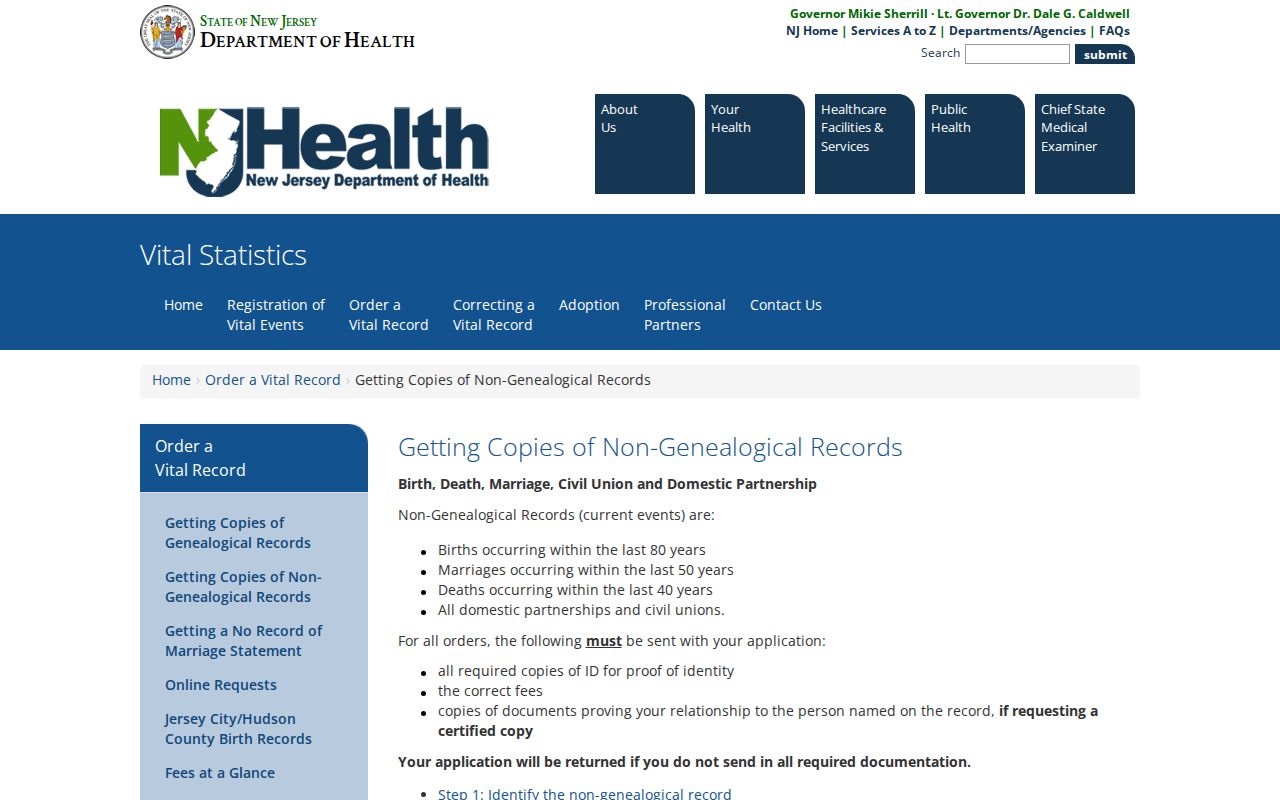
Older Union County events live elsewhere. The New Jersey State Archives genealogical collections hold births from May 1, 1848 through December 31, 1925, plus marriages and deaths from May 1, 1848 through December 31, 1950. Current records can be requested from the event municipality or the Department of Health by mail, online, phone, or walk-in, subject to the stated requirements and payment rules. State fees run $25 for the initial search and one copy or a no-record response, $2 for each additional same-record copy, with a stated 4-6 week state processing period. Local fees vary. Note: State requests mail the record to the ID address, and a different mailing address requires a notarized letter.
Union County Voter Status Limits
New Jersey's Voter Search checks one registration at a time. It does not hand out a general Union County residents list. Under N.J.S.A. 19:31-18, the statewide voter-registration list carries set fields. These are name, address, date of birth, party affiliation, and voting history. Signatures are excluded, and protected-person addresses may be left out. For the current BOE request workflow, fee, and delivery format, confirm details with the office first. Do not rely on any list request without that confirmation.
An inactive record does not mean someone left Union County. State guidance ties that status to returned mail or an address-confirmation notice. The voter stays inactive until the record is updated. The Union County Board of Elections takes voter-list and registration questions at 271 North Broad Street in Elizabeth. It also answers by phone at 908-527-4123 and by email. Keep the source date with anything you save. A dated civic record should never become a current-residence claim.
Union County Record Fallbacks
A blank search result is not a final answer. Land records that predate the online period can be requested from the Union County Clerk's Record Room. Images never published can go through the certified-copy route. The Union Vicinage at 2 Broad Street in Elizabeth explains clerk procedures. It also covers public-terminal and copy procedures for court records outside the public display. NJ Courts allows its Records Request Form to be saved and submitted through JEDS. SCCO handles closed or archived processing. Court Rule 1:38 exceptions still control access.
For ordinary government records, file a focused request under the New Jersey Open Public Records Act. It is N.J.S.A. 47:1A-1 et seq. Name the custodian, record type, date range, and preferred electronic delivery. The Government Records Council says agencies generally respond within seven business days. That deadline promises a response, not a completed complex search. Standard GRC copy fees are $0.05 per letter page. They are $0.07 per legal page, with electronic copies generally free.
Union County Resident Date Gaps
Placing a person at an earlier date takes older published sources. Directories and newspapers can supply a dated lead. Union Public Library's Digifind collection includes both. The library materials carry a beginning-year discrepancy. Check it in the live catalog. Plainfield's Local History collections, the State Library, and the State Archives fill gaps. They cover years when a digital copy is absent. Remember that a directory entry shows what was printed at that time. It is not proof of title or a current address.
Household trails work better than one-person checks. The Union County city directories give the collection context. They also give the year-run context for that kind of search. Compare a directory year with a parcel record or deed date. Retain the publication date and the page. Note whether the entry is indexed by surname or street.
Note: A former surname, a missing middle initial, or a changed municipality name can create a false negative in otherwise careful searches.
Union County Resident Lookup Limits
OPRA opens most government records unless an exemption applies. Yet court rules, vital-record controls, redactions, and source-specific rules still govern what appears. Some absences are protections by design. The New Jersey Address Confidentiality Program gives qualifying survivors and protected applicants a substitute legal address. Daniel's Law covers judicial officers, law-enforcement personnel, prosecutors, DCPP investigators, and immediate household family. It lets them seek protection or removal of certain information. A redacted address may be lawful protection, not an indexing error.
Never infer a hidden fact from a blank, a sealed case, or a protected address. New Jersey harassment law includes N.J.S.A. 2C:33-4, and stalking is addressed in N.J.S.A. 2C:12-10. Keep the record URL, access date, and identifier with any conclusion so the custodian can correct an error.