
Union County Previous Residents by Era
Previous residents of a Union County address are traced differently by era. The County Clerk's Record Room preserves land transactions from 1857 to the present, but the online UCPA index has a much later floor. Historical directories can add a dated household layer, and the State Archives supplies older indexed and microfilmed material. The table separates a recorded transfer from an occupant lead so a name is not assigned more weight than its source supports.
| Source | Years It Covers | Where Held | What It Shows |
|---|---|---|---|
| County Clerk Record Room land transactions | 1857-present | Elizabeth Record Room | Recorded land documents; pre-1977 transactions are in book form |
| UCPA land-record index | June 1, 1977 through the live date displayed during research | Union County Clerk online | Name-indexed instruments and images where published |
| Plainfield Local History directories | 1868-1982 in the family-history guide | Plainfield Public Library | Dated directory listings, newspapers, maps, and local-history material |
| Union Public Library Digifind directories | 1942-2012, with a 1952-2012 database description | Union Public Library digital collection | Digitized people, business, institution, and location listings |
| New Jersey State Archives genealogy collections | Varies by series | State Archives | Historical vital, court, naturalization, newspaper, and Union research paths |
Begin with land records for title history. Use directories and newspapers to test who appeared at the address in a dated publication. Neither source alone proves every person who lived there before.
Trace Union County Past Residents
First freeze the modern description of the Union County property: municipality, street number and spelling, ZIP, block, lot, parcel or PIN if supplied, assessment year, and current owner or taxpayer name. The New Jersey Property Explorer searches by address, county, municipality, block, and lot. It displays owner or location where not redacted, block and lot, assessed land and building values, prior-year taxes, classification, and map location. Its annual tax source can lag a later recording.
- Search the current owner as a grantee in the Union County Clerk UCPA index and locate the newest deed image when one is published.
- Record grantor, grantee, execution and recording dates, instrument number or book and page, legal description, consideration if shown, and every prior-deed reference.
- Search that earlier grantor as the next grantee, trying exact, starts-with, Soundex, and relevant spelling variants.
- Use book-and-page or instrument-number mode to validate each link. Use date-range mode for nearby filings only when the document number is unknown.
- Move to the Elizabeth Record Room for book-form indexes, unavailable images, or pre-1977 links that cannot be confirmed online.
- Grantor
- The party transferring an interest in the recorded instrument.
- Grantee
- The party receiving the interest. In a backward search, a prior grantor is often searched next as grantee to locate that party's earlier purchase.
- Chain of title
- The linked sequence of recorded instruments used to follow title from one party to an earlier party.
- Legal description
- The property description in the instrument. It is often a steadier historical key than a street address that changed format or lot configuration.
A recorded deed identifies parties to an instrument. It does not by itself establish who occupied the address. Keep a separate column for every historical household finding.
Union County Past Residents Paper-Web Divide
The important Union County previous-residents quirk is the gap between the shelf and the screen. The Clerk's public land trail reaches back to 1857, while the online index began June 1, 1977. In the period after that cutoff and before 1986, the index is online but older imaging may still be incomplete or being scanned. From 1986 forward, more images are expected, but the particular image and any redaction still require checking.
The Clerk's help says online land records are indexed by name only. It does not document an address-only deed search. That is why a parcel result and owner name belong before the UCPA deed search. A parcel tool locates a property lead, the Clerk records title instruments, and a historical directory preserves a dated listing.
The Clerk's certified-copy request page documents the copy route. It asks for instrument number, document type, recording date, book/page if known, requester information, page count, copy count, and certification choice. Visa and Mastercard are accepted, and the page says copies are mailed through USPS in 3-5 days. Verify the current document-specific charge before ordering.
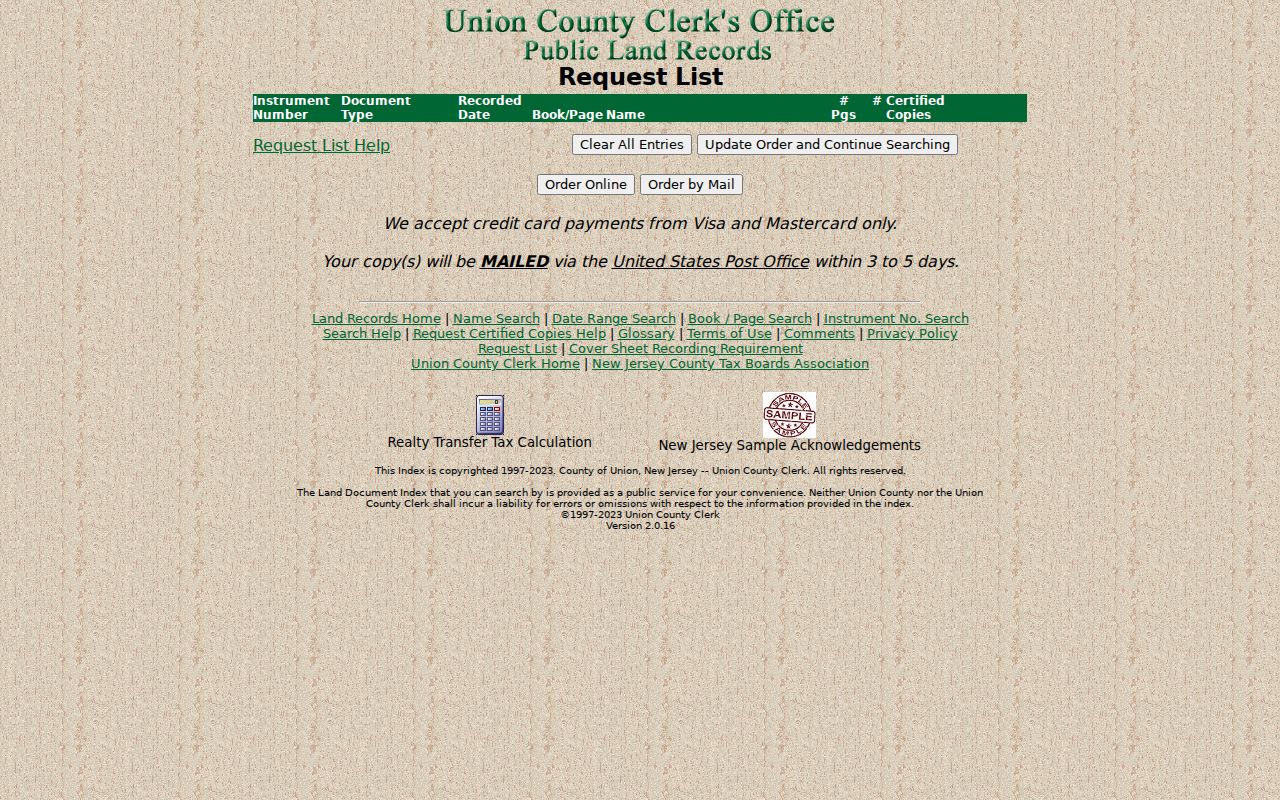
The request form is for a known document trail. It is not evidence that an address-only search or a particular image is available online.
Union County Past Residents and Title
Previous residents research needs two labels from the first note onward: recorded owner or instrument and occupant or directory entry. A deed may identify a purchaser, trust, or other grantee without saying who used the address. A city directory can place a household at a street address in a dated issue without showing title. Mailing addresses add a third caution because they can be outside the parcel's municipality.
For the current tax layer, retain both the situs address, which locates the parcel, and any owner or taxpayer mailing address as separate fields. NJGIN warns that parcel polygons are not legal boundaries or surveys, and state-hosted layers may redact owner names under Daniel's Law. Use a map to orient the record, then verify the claim with the assessor or recorded document.
Note: A present-day parcel map can bridge old and new descriptions, but it should not be treated as proof that a historic lot had identical boundaries.
Union County Past Residents Plainfield Quirk
Plainfield Public Library offers a concrete Union County house-history method. Search a city directory from a library computer for a past owner, then search blueprints by last name. For the street query, the library advises omitting Street or Avenue, using full names and abbreviations for numbered streets, and omitting directional prefixes. This normalization can expose an old address form that a literal search misses.
Plainfield Local History collections include directories, blueprints, local newspapers, maps, and research material. Not every blueprint is online, newer blueprints may be at City Hall, and microfilm work may still be required. The method is a documented Plainfield practice, not a claim that every Union County municipality uses the same archive or naming convention.
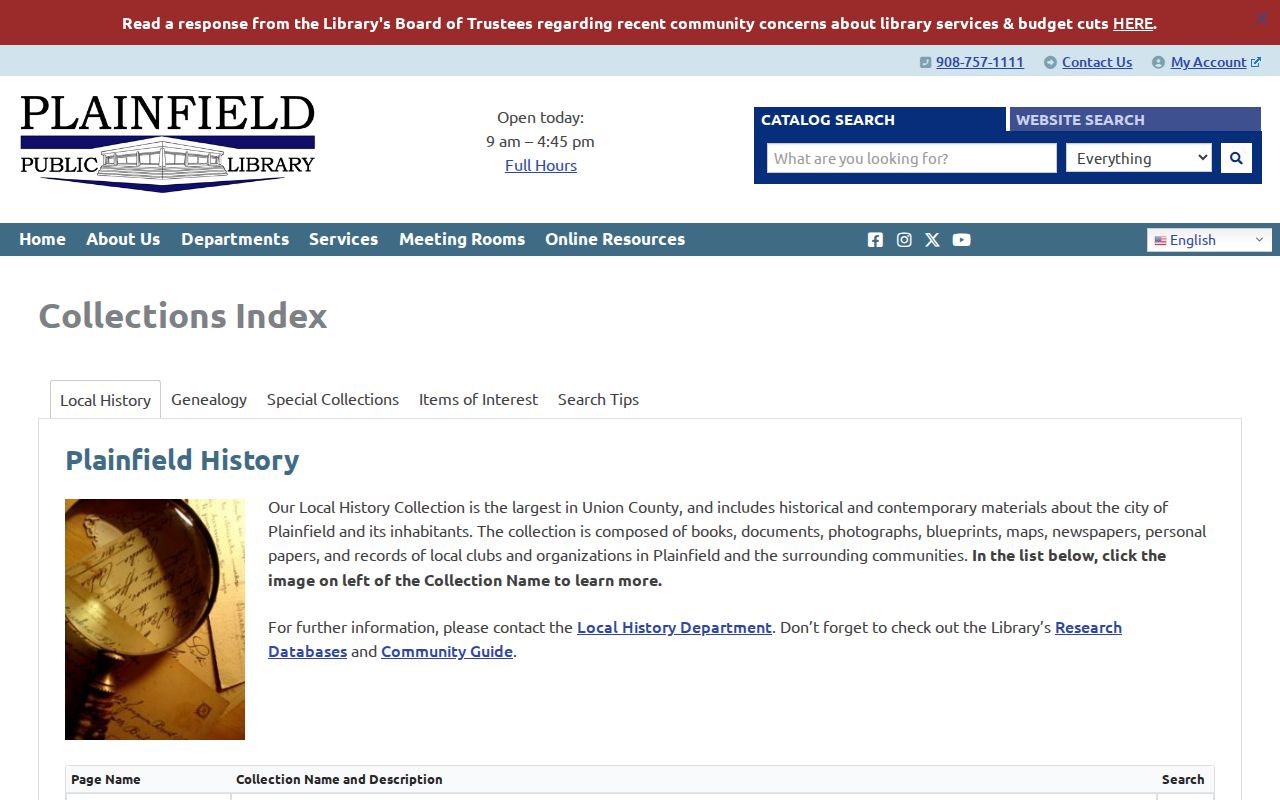
The collection view explains why library materials matter between deed dates. A blueprint can date an alteration or identify an owner or applicant, but it must be read with the record's own access and disclosure limits.
Union County Past Residents Household Trail
After the title chain is dated, build the household layer with directories, census, and newspapers. Plainfield's family-history guide names city directories for 1868-1982 and points to local census material and newspapers. Union Public Library's digitized directory descriptions cover 1942-2012, with the separate 1952-2012 catalog description noted in the library research. Select the issue nearest a deed date, then keep each source's date in its own column.
- Choose the oldest deed date or directory year tied to the same legal description or normalized address.
- Search the directory by surname and, where the issue supports it, street or address material.
- Compare the closest later issue before inferring a move, death, or changed household.
- Pair the dated listing with the nearest census, newspaper notice, obituary, or archive index.
- Mark the result as an occupant lead until an independent record supports the identity and date.
The historical volumes themselves are described in the Union County city directory collections. Use them for the household layer while leaving the recorded deed sequence in its own chain.
Union County Past Residents Archives
The New Jersey State Archives genealogy collections provide a fallback when a Union County deed, directory, or newspaper trail ends. The Archives lists Union County original Court of Common Pleas naturalizations from 1857-1948, Chancery material from the 1740s-1948, and name-change judgments from 1876-1947. It also holds historical births from May 1, 1848 through December 31, 1925 and marriages and deaths from May 1, 1848 through December 31, 1950.
The State Archives genealogy collections use a Microfilm Room and mail or in-person research paths for older material. Historical records may identify a family event or former name, but the record's date, jurisdiction, and access rules control its meaning. Union County was created in 1857, so an earlier place-based record can sit in a parent county or different court series.
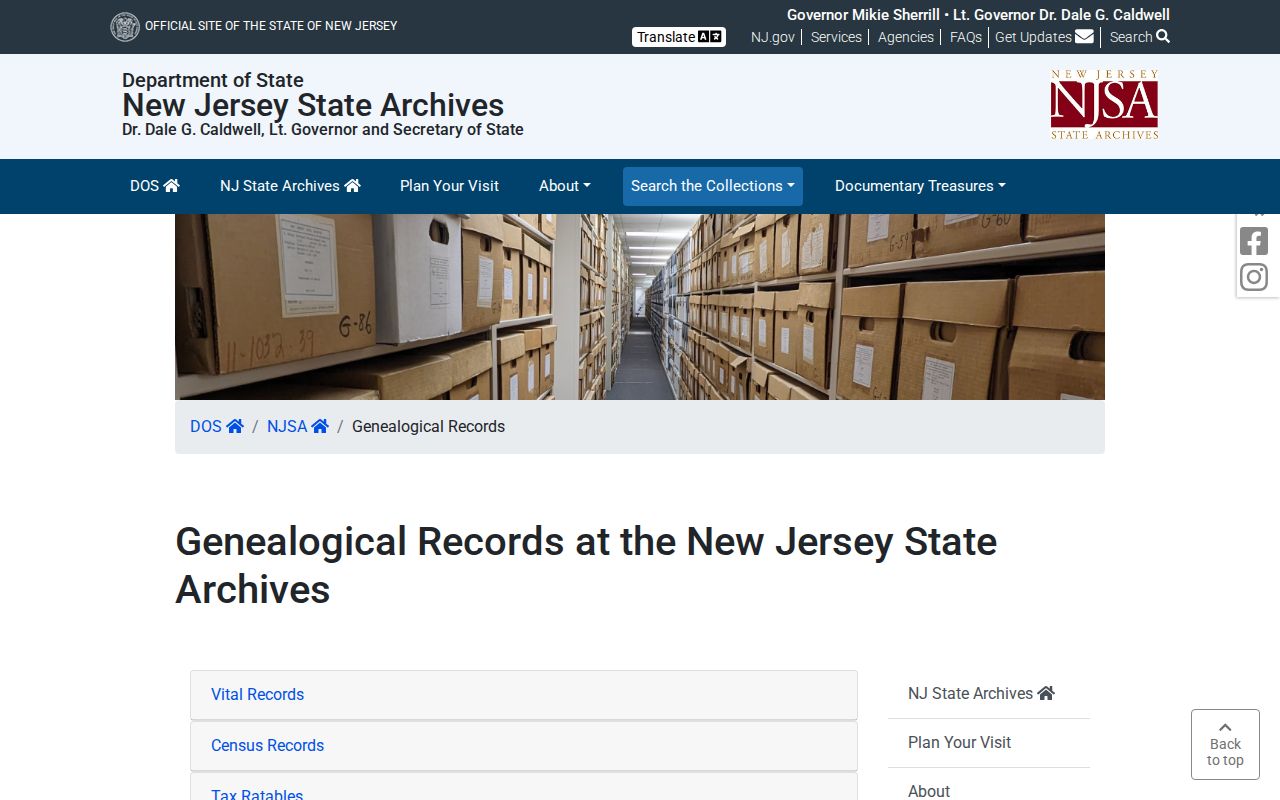
The Archives collection is a route to original or microfilmed historical material, not a substitute for confirming the parcel's legal description in the Clerk's land record.
Union County Past Residents Address Changes
No county-wide Union County street-renumbering schedule was located in the research. Avoid inventing a renumbering year from a modern map. Instead compare old directory forms, municipal maps, deed legal descriptions, historic atlases or Sanborn material when a holding is confirmed, assessor history, and street indexes. Record the source year beside each address form.
Subdivision, consolidation, road work, municipal boundaries, and changing postal labels can break an address trail. A property that changes from one legal lot to two should begin a new parcel history with a cross-reference to the former description. The research did not locate a county-wide current Sanborn index or exact years for every municipality.
Union County Previous Residents Access Paths
Use the online UCPA index for post-1977 name-indexed instruments, the Elizabeth Record Room and staff for book-form entries or unavailable images, and 908-527-4787 for Clerk office contact. The Board of Taxation and municipal assessor route supports tax-list context, while Property Explorer and NJGIN support parcel orientation. Ask Union Public Library and Plainfield Local History for directories, newspapers, maps, and house-history methods; use the State Archives and historical organizations for older context.
For a non-indexed county administrative record, a narrow request under the New Jersey Open Public Records Act can be sent to the appropriate custodian. It does not bypass a sealed, redacted, protected, or otherwise restricted record. Preserve the source URL, record date, and identifier rather than building a profile from partial matches.
Lawful use. Union County previous residents research is appropriate for family history, estate questions, property history, and personal curiosity. Do not use a historical finding to track, harass, threaten, or expose a living person.